

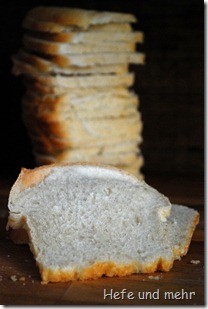
 I don’t like Sandwich bread so much – normally. Especially I am not a big friend of toasting sandwich bread – but thats the kind of bread that my boyfrind love and so I bake this kind of bread, too. And I like the challenge to create a soft and fluffy light bread.
To archive a regular crumb which you can tear away in long fibres you have to knead the dough intensively and degas the dough very well before forming a loaf.
This tricks I used for sandwich breads before, but when I saw the extra soft Sandwich bread of TXFarmer at Yeastspotting I note all the Tips and Hints in Handling the dough. The Sandwich bread of TXFarmer contains egg white instead of whole eggs. That’s add extra protein to the dough which makes the crumb more stable without changing the look or taste of the bread like adding whole egg or egg yolk would do.
For a very even crumb the dough is flatted, rolled into a log and flatted again before rolling it into a loaf. That press all of the air bubbles out of the dough.
The resulting bread is great. It is very soft and fluffy, and it get a nice brown colour when toasted, but without getting dry. Because of the two preferments it tastes delicious, too. The taste reminds me of mild yoghurt with a hint of acid but not so sour that it overpowers the other aromas.I have to say that I like it very much and baked it already twice.
Sandwich bread with two preferments
yields two breads of 1 kg each
Sourdough
- 150g water
- 150g flour Type 550
- 15g Starter
- 90g flour Type 550
- 65g water
- 1g fresh yeast
- 2g Salt
Water roux
- 60 g flour Type 550
- 300g water
Dough
- 800g flour type 550
- 200g milk
- 120g egg white (of 3 big eggs)
- 50g sugar
- 100g Butter
- 20g Salt
- 5g fresh yeast
Mix all ingredients for the sourdough and ferment overnight (12 to 16 hours) on a warm place (about 25°C).
Mix all ingredients for the Pâte fermentée and knead for 3 min, then ferment it for 1 hour at room temperature. Then put the dough into the fridge for at least 12 hours.
For the water roux whisk water and flour until lump free, then heat it up to 65°C (needs about 3 min) while whisking. Fill the water roux in a bowl, cover its surface with cling foil and let it cool down to room temperature.
Dissolve the yeast in the milk, add flour, egg white, water roux, Pâte fermentée and sourdough and knead 5 min at slowest speed, then around 11 min on fast speed until complete gluten development. Now add sugar and butter and knead for about 2 min until butter and sugar are complete incooperated.
Ferment for 3 hours.
Degase the dough and 8 parts of about 250g each.Form them to balls and let them Rest for 20 min. Roll each Ball into a long thin oval. Fold the long sides into the middle to form an rectangle. From the short roll tightly to a log. Now roll it again along the seam to an long, thin oval, fold the long sides into the middle and roll again tightly to a log. The log should be as long as the baking pan is wide. Place four logs in a buttered pan (30 cm long) proof for 6 hour.
Bake with steam at 175°C for about 50min.
Deutsch
Vielen lieben Dank für deine Hilfe, die werde ich versuchen. So wie ich das lese, macht das Ausrollen und Aufrollen auch eine langfasrige Krume. Das wusste ich nicht. Ich dachte das hängt hauptsächlich von der Zutat Milch, Zucker ab.
Ganz liebe Grüße Bernadette
@Bernadette: Gerade Fett und Lecitin (Eigelb) beeinflusst die Krumenstruktur, aber auch das Formen spielt eine große Rolle 🙂 Durch das Rollen oder Flechten gibt man den Glutennetzwerk stärker die Richtung vor, wodurch die Langfasrigkeit entsteht.
Hallo,
ich finde dieses Toastbrot super, vor allem die langfasrige extrem weiche Krume. Da brauche ich keinen Toast mehr kaufen. Ich liebe so weiches Brot/Brötchen. Könntest du mir einen Tipp geben, wie ich auch so tolle Brötchen mit einer gleichen Krume backen kann? Aber nicht als “Milchbrötchen” sondern die deftige Variante für eine Brotzeit? Oder brauche ich eine bestimmte Zutat wie Milch, Zucker,… damit sie so langfasrig und weich und fluffig werden?
Liebe Grüße
Bernadette
@Bernadette: öchtest du eine knusrige Kruste? Das wird etwas schwieriger. Ansonsten sind die ganzen Burgerbrötchen eine gute Wahl.
Knusprige Kruste wäre super. Ja ich weiß, ist nicht einfach. Ich suche svhon lange nach einem passenden Rezept.
@Bernadette: Das Problem ist, dass je höher der Fettanteil ist, desto flauschiger wird die Krume und desto weniger knusprig ist die Kruste. Aber auch durch die Aufarbeitung kann man die Krume beeinflussen. Versuch mal die Dinkel-Haferlis, ob sie in die richtige Richtung gehen.
Hallo Stefanie,
das Rezept müsste doch sicher auch mit Dinkelmehl funktionieren oder was meinst du?
Danke für deine tollen Rezepte im Blog.
@Christine: Das funktioniert auch mit Dinkelmehl, pass aber beim Kneten auf, dass du den Teig nicht überknetest. Mach zwischendurch einen Fenstertest, um die Glutenentwicklung zu überprüfen!
Vielen Dank für die schnelle Antwort. Wird bald getestet, die Kinder lieben den neuen Sandwichtoaster, und ich finde das Supermarkt Toastbrot unsäglich.
@Christine: Falls deine Kinder auch ein ganz klein wenig Vollkorn im Toastbrot mögen, ist vielleicht auch dieses Dinkel-Toast etwas für euch. Und das deine Kinder den Sandwichtoaster mögen, kann ich gut verstehen, ich packe ganz gerne auch das “normale” Brot in den Toaster, dass hat dann noch mehr Biss und ist gerade für ein etwas altbackenes Brot eine gute Alternative! Und warmes Brot mit geschmolzenem Käse ist einfach unschlagbar 😀
Hallo Stefanie,
Heute möchte ich mal das Toastbrot ausprobieren. Das Brot soll ja 6 Stunden in der Form gehen. Bei Zimmertemperatur oder im Kühlschrank?
Andrea
@Andrea: Bei Raumtemperatur. Wenn du möchtest, kannst du es aber auch über Nacht in den Kühlschrank stellen.
Hallo Stefanie,
bin vor kurzem erst auf deinen Block gestoßen, aber schon fleißig am nachbacken! Es ist einfach alles super erklärt!
Jetzt aber mal ne Frage zum Toastbrot: bin kein großer Sauerteig-Fan, kann ich ihn auch durch Lievito Madre ersetzen? Und wenn ja, wieviel nehm ich da?
Liebe Grüße
@Annette: Das kannst du natürlich machen (auch wenn Lievito madre technisch betracht ja auch ein Sauerteig ist). Du musst dann aber die Wassermenge anpassen. Ich gehe mal davon aus, dass du deinen Lievito madre mit 50g Wasser auf 100g Mehl führst? Wenn ja, dann würde ich 225g Lievito madre verwenden, und dem Teig zusätzlich 75g Wasser hinzufügen.
Vielen lieben Dank!
Das Brot ist absolut klasse geworden. Wenn ich gewusst hätte wie einfach das geht hätten wir schon lange auf das Gekaufte verzichtet!
@Annette: Das freut mich sehr! Die Variante mit Lievito madre muss ich auch mal ausprobieren!
Hallo Stefanie!
Wäre es auch möglich das Toastbrot über Nacht ein wenig kühler (kellerkalte 15 Grad?), dafür aber länger zur Gare zu stellen(ca. 9 -10 Stunden)? Dann könnte man am nächsten Morgen doch glatt frisches warmes Toastbrot genießen…
Viele Grüße
Susen
@Susen: Das kannst du natürlich machen. Allerdings lässt sich das Toastbrot solange es warm ist nicht so gut schneiden, da die flauschige Krume dabei zerdrückt wird.
Pingback: Hefe und mehr » Blog Archive » Schokoladenbrot
Благодарю за интересный рецепт! Ссылку на ваш сайт я добавила, думаю, что вы не в обиде за то, что я использовала ваш рецепт. В будущем буду ссылаться на ваш сайт.
öhm…. entgasen?!?
was bedeutet das? falten oder kneten?
danke!
p.s die hellen dinkelbrötchen waren toll 🙂
@ frisi: Entgasen heißt, die Luftbläschen mit den Händen aus den Teig drücken, dafür knete ich aber nicht mehr, sondern drücke den Teig mit den Händen nur platt.
Schön, dass die Dinkelbrötchen geschmeckt haben 🙂
ah, das ist ja gar nicht so schwierig 🙂 danke!
und was ist der sauerteig starter? ich tippe auf sauerteig starter tag 1, oder?
Das ist der fertige Sauerteigansatz – auch Anstellgut genannt. Ich treibe mich nur zuviel auf englisch-sprachigen Blogs herum, und der Begriff Starter anstelle von Anstellgut ist bei mir kleben geblieben.
Very interesting, Stefanie. And the bread looks very nice. The crumb is perfect! Thanks for sharing all your tips with us 😀
Hallo Stefanie,
Dein Toast habe ich ausprobiert. Die letzte Gehzeit habe ich bei Kühlschranktemperatur vorgenommen. War das richtig? Ich habe das Teig- ausrollen und -aufwickeln nicht gemacht, weil der Teig so flüssig war. Ich dachte mir, das gibt bestimmt eine riesen Sauerei. Das Ergebnis ist trotzdem sehr gut. Ich habe in einer Toastbackform gebacken, es war etwas zuviel Teig (nächstes Mal werde ich nur 3/4 der Menge machen). Ich hatte im Teig 100 g Weizenvollkorn (das 550er reichte nicht), zudem noch geröstete Sesamen und oben drauf ungeröstete Sonnenblumenkerne. Sehr lecker!! Ich bin von Deinem Blog ganz begeistert und habe schon sehr viel davon gelesen. Deinen Hang zu Küchengeräten teile ich! 🙂
Viel backduftige Grüße, Diana
Pingback: Hefe und mehr » Blog Archive » “Normale” Brötchen
Pingback: Hefe und mehr » Blog Archive » Kürbis-Sandwichbrot–besonders weich und fluffig
Hallo,
ich habe ein paar Fragen zu dem Rezept
– welche Maße hat denn die Kastenform
– ich habe kein Startersauerteig bzw. kein ASG wie kann ich das ersetzen
– im Teig wird ja Mehl verwendet nimmt man da auch 550er?
Silke
@Silke: Die Kastenform ist 35cm lang und das Mehl im Teig ist auch 550er. Den Sauerteig komplett zu ersetzen ist bei diesem Rezept eher schwierig. Man könnte vielleicht einen Poolish anstelle des Sauerteigs machen und im Teig etwas mehr Hefe nehmen. Aber das würde den Geschmack des Brotes schon grundlegend ändern und auch beim Gehen sollte man dann ein Auge auf das Brot haben, dass könnte bei mehr Hefe schneller aufgehen. Einen eigenen Sauerteig anzuziehen ist aber auch nicht schwierig.