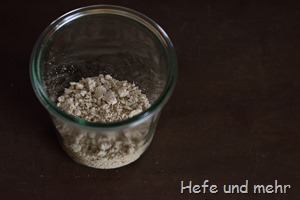
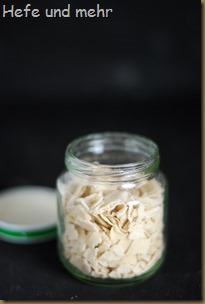
 Some days ago I had to sent some sourdough per mail. That is easy when the sourdough is mixed with a lot of flour to form dry crumbs – the German name for this is “Krümmelsauer” while it is called “Gerstl” in Austria. The crumbs should be as dry and fine as possible. This reduce the amount of water and put the microorganisms to hibernation. In this state there is nearly no fermentation going on.
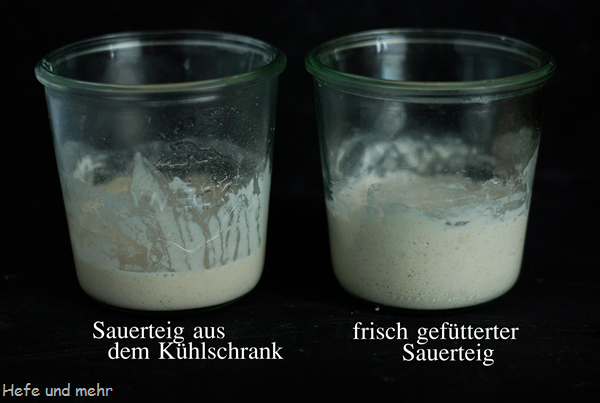
Reactivation is easy as well. Mixing the “Krümmelsauer” with water and waiting until the first bubbles are showing. And as I realised that I never showed this kind of sourdough conservation on the blog, I made a double batch. One halve I sent to Berlin, the other one I kept for three days on the counter to simulate the enviroment during mailing. Then I mixed the sourdough crumbles with water and as my sourdough is quite active I saw the first bubbles after one hours already. I let the mixture ferment for another five hours, then I used it to start a sourdough. And this sourdough doubled its volume easily overnight.
 Now we feeded our new sourdough for for four or five days and it is happy bubbeling. But how to proceed now? Here is an overview on how to care for a sourdough: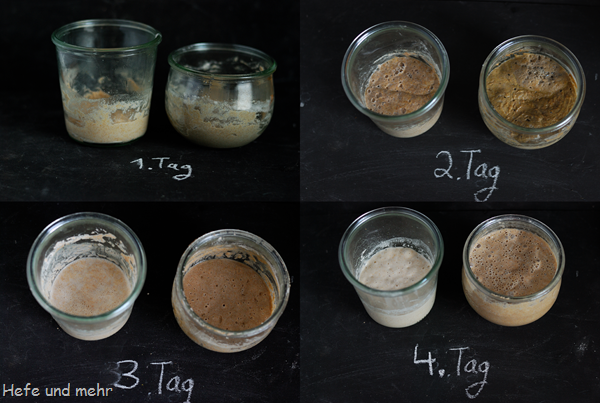
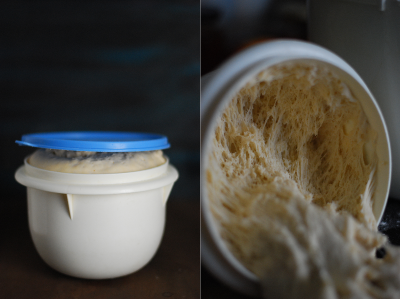 A sweet Starter, sometimes called italian starter as well, is a sourdough which rises very strong due to high temperature and frequent feeding. The yeasts in the sourdough develop very strongly under this conditions, while the bacteria produce less acids. This yields into the very mild taste of this starter.
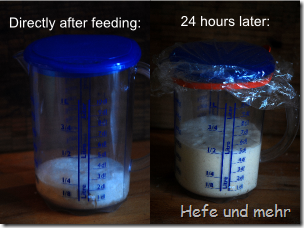 In a comment to one of my bread recipes the preferment livito madre was described, with a link to the
 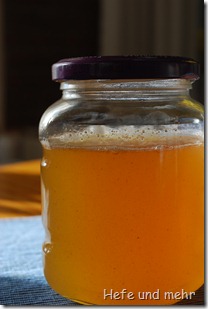 I love (kitchen)experiments. And when they are bubbling and fizzing I love them even more. That’s the reason why I could not resist when I read about
 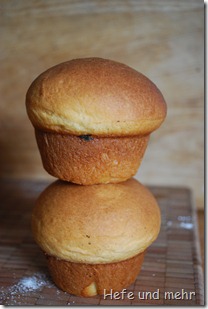 Michael Suas recommend in “advanced bread and pastry” to create a sweet starter to bake sweet bread like Panettone or Pandoro. Due to rising this starter on high temperature and many feedings, the growth of wild yeast is encourage as wells as the growth of homfermenting lactobacilli while bacteria producing acetic acid are inhibited by the high temperature. This produce a very vigorous but jet very mild tasting sourdough.