

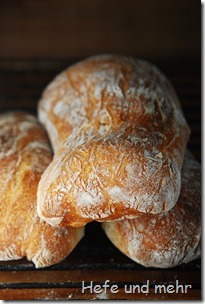
The Baguette with the long, cold fermentation was so delicious, that I started to though about using the same methode to bake Ciabattas. And because I did not bake Ciabattas for a quite long time, I did not only think about it but mixed directly a dough.
The dough needs a long time in the fridge, about 24 hours or longer, but the hand-on time is very short. At the beginning you have to fold the dough three times during the first hour, and then the dough slumbers in the fridge. At the baking day, you have only to preheat the baking stone and form the ciabatta. That makes the whole process really relaxing.
The dough is very soft, but gains a good gluten network during folding. With a well floured countertop and a dough scrapper it is easy to form the ciabatta. During the fermentation big air bubbles are already formed in dough.
The bread has a very open crumb with big holes and a crunchy crust. The long fermenation adds a lot of complex aroma with a fruity hint due to the olive oil. A very good bread!
Ciabatta
yields 4 Ciabatta
- 500g flour Type 550
- 375g Water
- 25g Olive oil
- 3g fresh yeast
- 10g Salt
- 10g inactive Malt (optional)
Dissolve the yeast into the water and add the mixture to the other ingredients in a bowl. Mix all ingredients for the dough. Let it rest for 20 min, then fold it from the outside of bowl into the middle for three or four times. Let rest for 20 min again, then fold the dough and repeat the resting and folding steps one time more.
Ferment the dough for 24 – 48 hours in the fridge. After 12 and 24 hours fold the dough again.
Heat baking stone in the oven to 250°C.
Flour the countertop and carefully turn the dough on it. Divide the dough with a dough scrapper into four pieces. Gently stretch the dough pieces to the typical ciabatta shape.
Lay on a couche (floured) and cover with a second cloth and proof for 50 min.
Bake on the preheated stone for 35 min with steam.
I sent this entry to Yeastspotting, Susans weekly showcase of yeast baked good.
Deutsch
Liebe Stefanie,
ich würde mich gern an Dein Rezept herantasten. Nun habe ich allerdings ein sehr glutenstarkes Mehl, welches ich hier probieren würde: Eiweiß 16,5%, W-Wert 460.
Dazu hätte ich Fragen:
Wieviel Wasser (nur so etwa) könnte ich hier nehmen? Hättest Du hier evtl. einen Tipp für mich?
Wenn man den Teig etwas ankneten würde (wegen der Glutenmenge), wäre das für die großporige Krume eher gut oder schlecht?
Sollte ich die Kühlschrankzeit dann verlängern?
Ich würde sehr gern das Mehl probieren, auch wenn vom Glutengehalt jenseits unserer Mehle liegt, bin aber unsicher bei meinen Fragen.
Liebe Grüße
Hallo, mir ist aufgefallen, dass du immer sehr wenig Hefe nimmst, wie funktioniert das?
Bisher habe ich immer einen Würfel auf 1kg Mehl genommen…
Viele Grüße Inga
@Inga: Wenig Hefe funktioniert, wenn die Gehzeiten entsprechend etwas länger sind. Durch die längeren Gehzeiten profitiert nicht nur das Aussehen der Krume (typische große Ciabatta-Poren), sondern auch der Geschmack wird vielschichtiger und sogar die Verträglichkeit wird verbessert (Stichwort Fodmaps). Es klappt sogar mit noch weniger Hefe, s. z.B. hier.
Geniales Rezept! Als Mehl habe ich 370 g Manitobo und 130 g Tipo 00 genommen.
Der Ofen wurde bei 270 Grad vorgeheizt. Gebacken habe ich 10 Min. bei 270 Grad dann 15 Min. bei 250 Grad und bei ausgeschaltetem Ofen und etwas geöffneter Ofentür 5 Min.
Das Ergebnis war umwerfend. Noch nie so gut.
@Sigelinde: Das freut mich sehr 😀
Hallo Stefanie ,
ich habe das richtig verstanden : der Teig wird nur “verrührt” , aber nicht geknetet ?!
Steht auch bei der Foccaccia aus “Hefe und mehr” .
Lieber Gruss
@Christa: Ganz genau. Anstelle des Knetens wird das Klebergerüst hier durch das Falten des Teiges entwickelt-
Hallo Stefanie ,
lieben Dank für deine Antwort !
Jetzt kann ich es verstehen .
Ganz liebe Grüsse
Christa
Hallo, ich möchte gerne die doppelte Menge Ciabatta auf 2 Blechen in einem Rutsch backen. Eignet sich hierfür dann auch Umluft mit 20 Grad reduziert? Da der Teig doch relativ feucht ist, dürfte er normal auch nicht austrocknen beim Backen mit Umluft. 🤔
@Andrea: Ich habe auch bei feuchteren Teigen keine guten Erfahrungen mit Umluft gemacht, die Oberfläche trocknet einfach zu schnell aus und wird matt. Die einzige Ausnahme sind Öfen mit Klimagarfunktion, da die Luft im Ofen mit Dampf gesättigt ist.
Du kannst versuchen, sehr kräftig zu schwaden. Wenn der Ofen dampfdicht ist (sind Öfen, die Pyrolyse können eigentlich immer), könnte das klappen. Die Temperatur muss dann in jedem Fall um 20-30°C gesenkt werden.
Hallo Stefanie, ich backe erst seit kurzem Brot und Brötchen. Aus dem Teig habe ich Ciabatta -Brötchen gebacken und einen Teil der Hefe durch Lievito Madre ersetzt. Außerdem habe ich Mehl Typ 0 verwendet. Ich hatte noch nie bessere Ciabatta-Brötchen. Rasanter Ofentrieb. Allerdings sind sie etwas dunkel geworden, obwohl ich die Backzeit deutlich reduziert habe. Hast Du einen Tip für mich? Weniger Malz?
Danke für Deine tollen Rezepte.
@Margaretha: Es kann sein, dass durch die Madre mehr Stärke und Proteine abgebaut wurden. Dann stehen mehr Zucker und Aminosäuren für die Maillardreaktion zur Verfügung und das Brot bräunt schneller. Daher würde ich den Malz mal ganz streichen 🙂
Hallo Stefanie, ich habe das Malz jetzt weggelassen und die letzen 5 Minuten die Oberhitze abgeschaltet, das hat super funktioniert.
Eine Frage habe ich noch, die Du mir vielleicht bitte beantworten könntest.
Ich hab die Ciabatta (als Brötchen) einmal mit Lievito Madre und einmal nur mit Hefe gebacken. Ich finde mit LM schmecken sie noch besser. Wieviel LM würdet Du zusetzen?
Kommt dann gar keine Hefe mehr dazu?
@Margaretha: Schön, dass es geklappt hat 😀 Du kannst 75g LM zusetzen und dafür im Rezept 50g Mehl weniger und 25g Wasser weniger verwenden.
Super, vielen Dank für die schnelle Antwort.
Danke für die schnelle Antwort. Ich setz gleich nochmals Teig an, mein Mann war begeistert, auch wenn die Ciabattas braun waren. Geschmeckt haben Sie toll und sie waren super luftig.
Hallo Stefanie, geschmacklich super, Konsistenz ebenfalls. Nur die Optik war nicht wirklich schön, kann sie auch irgendwie anders in Form bringen? ZB nur längs teilen damit das auseinanderziehen wegfällt, mein Teig war so weich und auch noch klebrig das es nicht wirklich funktioniert hat. Oder einfach etwas mehr Mehl nehmen ?
Stefanie
Danke schöne weihnachten
Hallo Stefanie,
Habe ich dann 4 Brote ? Verstehe das nicht so ganz.
Stefanie
@Stefanie: Genau, das Rezept ergibt 4 Ciabatta (sollte ich mal nachtragen…)
Dieses Ciabatta gehört schon fast zu unserem Wochenend-Standardprogramm, absolut gelingsicher
und superlecker! Jetzt habe ich aber ein kleines Problem… Ich habe heute Abend den Teig angesetzt
und wollte es mal – aus zeitlichen Gründen – 3 Tage, also knappe 72 Stunden gehen lassen. Jetzt kommt
unser Besuch aber doch erst am Samstag, das wären dann ja nochmal 24 Stunden mehr. Das ist zu lange,
oder? Die Alternative wäre vorher backen und einfrieren!?
Herzliche Grüße
Anja
@Anja: 96 Stunden sind in der Tat kritisch, da die Abbau-Prozesse im Teig schon recht weit fortgeschritten sind. Wenn es deine Zeit zulässt, würde ich die Ciabatta schon am Freitag (halb-)backen, sie also kürzer im Ofen lassen. Eine Backzeit von 20-22 min sollte ausreichen, damit sie durchgebacken, aber nicht oder nur minimal gebräunt sind. Nach dem Auskühlen packst du sie in eine Plastiktüte oder Dose und lagerst sie bei Raumtemperatur. Am Samstag kannst du sie dann bei 250°C etwa 15 min zu Ende backen. Back sie ein bisschen auf Sicht, sie sollten am Ende eine schöne Bräunung aufweisen.
Kann ich den Ciabattateig auch länger als 48 Stunden gehen lassen?
Ich habe den Teig heute (Donnerstagabend) angesetzt, da ich morgen Abend keine Zeit habe und das Ciabatta am Sonntagabend benötige.
@Simone: Das sollte kein Problem sein!
Hmmmm, mit Dinkelmehl, 36 Stunden im Kühlschrank und dann im heißen Gusstopf gebacken – sehr gefährlich, weil man es sofort aufessen muss, sooooo lecker! Vielen Dank auch für dieses Rezept.
Pingback: Bread & Companatico | 24-Hour Sourdough Loaf With Durum
Pingback: Dinkel-Baguettes | Hefe und mehr
Pingback: Ciabatta | waehnerk
Pingback: 24-Hour Sourdough Loaf With Durum » My Italian Smörgåsbord
amazing job and it sounds so laid back to let the fridge do most of the work! this I am definitely going to try soon!!! ciao
Ach` Malz, wie dämlich, da hätte ich lange nach inaktivem Salz suchen können 😀
Da hab` ich mich wohl verlesen. Inaktives Malz habe ich hier. Danke 🙂
Sieht lecker aus! Was ist inaktives Meersalz bzw. was bewirkt es?
Liebe Grüße Helena
@Helena: Danke schön 🙂 Das inaktive Malz (nicht Meersalz) gibt dem Brot ein etwas runderes Aroma, ein Teil dient der Hefe als Nahrung, und beim Backen sorgt es dafür, das die Kruste schön braun wird. Gerade bei einer so langen Führung kann es passieren, dass der meiste Zucker im Mehl von der Hefe “aufgefressen” wird und das Brot bleibt beim Backen blass.
hi…
die hefe “frisst” den zucker auf, bildet co2 und alkohol als lockerungsgase…
allerdings, durch die lange teigführung und den damit resultierenden enzymatischen abbau der stärke zu einfachzuckern, in kombination mit dem enzymatischen abbau des eiweißes entstehen so neue bausteine die als grundlage für die maillard reaktion dienen…
das brot bleibt also nicht blass, es entwickelt eine tolle bräunung bei einer langen teigführung, ganz ohne malzzugabe =)
gruß aus dem ruhrgebiet, andy, bäckermeister
@Andy: Klar wird bei der langen Stockgare auch Zucker durch den abbau der Stärke frei, aber auch entsprechend verbraucht. Und wenn man ein wenig Malz hinzugibt, verbaucht die Hefe erst das Malz, und es bleibt mehr Zucker für die Maillard-Reaktion übrig und das Brot wird dunkler als ohne. Und das finde ich persönlich schön 🙂