

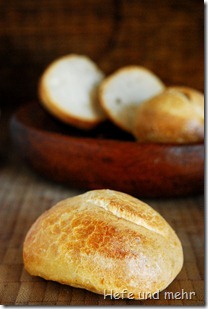
 In the different regions of Germany plain rolls have different names: In the north they are called “Rundstücke”, in the South “Semmeln” or “Wecken” and in the East they are called “Schrippen” or “Doppelte”, and in the West, were I live, we call them “Brötchen”. But as a friend who has to travel a lot told me some days ago, as long as you asked for “Normal” you will get what you want in every bakery.
I still try to create rolls with a fluffy and soft crumb. I will not give up this aim, someday I will get the ingredients in the perfect ratio like it work for the sandwich bread, too.
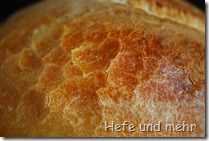
My newest attempt include some egg white, a little bit of milk and butter. I used some Pâte fermentée and knead until the gluten is fully developed. The crumb is already much better then before, it is evenly regulary and softer then before, but not as soft as I whished for. The rolls proofed nicely and had a good oven spring. Pulling them out of the oven they started directly to “sing” when the crust cracked because of the soft crumb which shrink when the bread cool down.
For Baking I test a new idea I had to create steam. I placed the rolls on a deep baking sheet and place a small bowl with boiling water on the pan, too. Then I covered everything with a second deep baking sheet and put everything in the oven. You have to be carefully when placing or removing this in/from the oven because of the boiling water! The lot of steam which stayed near to the rolls improved the oven spring very much!
The rolls are good, very aromatic because of the long, slow rise. I like the taste of the “Normal” rolls very much and will try to improve the crumb further.
“Normal” Rolls
- 250g flour Type 550
- 250g Water
- 1g fresh yeast
Dough
- Poolish
- 800g flour
- 50g Egg white
- 75g Milk
- 325g Water
- 50g Butter
- 3g fresh yeast
- 20g Salt
Glazing
- 2g Starch
- 100g Water
In the morning: Mix all ingredients for the Poolish and ferment for 12 hours on a warm place (about 25°C).
In the evening: Dissolve the yeast in the milk, add water, flour, egg white, salt and Poolish and knead 5 min at slowest speed, then around 11 min on fast speed until complete gluten development. Now butter and knead for about 2 min until complete incooperated.
Ferment overnight (8 – 10 hours).
The next morning: Divide the dough into pieces of about 85g each. Shape into rolls.
Proof for 60 min. Heat the oven to 250°C in the meantime. For glazing cook starch with water and let cool to room temperatur
Before baking glaze the rolls and slash them lengthwise and bake at 250°C for 15 min with steam. Open the oven doorto release the steam, glaze again and bake another 10 min to get a crispy crust.
I send this entry to yeastspotting, Susans weekly showcase of yeast baked goods.
Deutsch
Hallo Stefanie,
diese Brötchen möchte ich sehr gerne nachbacken. Meine Frage hierzu lautet:
Wie gehe ich vor, wenn ich einen Brötchenstempel für Kaiserbrötchen verwenden möchte? Nach dem Schleifen gleich stempeln und umdrehen für 60 min.?
LG
Chris
@Chris: Genau so würde ich vorgehen. Damit sich die Brötchen gut stempeln lassen, sollte man den Teig aber ein wenig fester halten.
Pingback: Hefe und mehr » Blog Archive » Flockenbrötchen
Pingback: Hefe und mehr » Blog Archive » Krusti
Pingback: Krustis nach Stefanie Herberth – Plötzblog – Rezepte rund ums Backen von Brot, Brötchen, Kuchen & Co.
Hello, Stefanie,
For everybody who wants to bake your breads in the US – though Typ 550 has the highest protein content of German flours, it is more like American all-purpose flour. And German all-purpose Typ 405 is more like US pastry flour.
Happy baking,
Karin from Maine
Hallo Stefanie, das Rezept muss ich unbedingt ausprobieren und dass das wieder ein über-Nacht-Rezept ist erst recht super, aber wieviel ist 50g Eiweiss? Herzlichen Gruss Nadja
@Nadja: Das ist ungefähr das Eiweiß von 2 Eiern Größe M
Ich werd’s testen! Und zwar mit dem vollen Kilo Mehl, denn der Aufwand ist für von-Hand-Kneterinnen ja nicht ohne. Deshalb hätte ich gerne Deinen Tipp, wie ich die Brötchen dann am besten einfriere. Ich brauche ja maximal ein Stück pro Tag… Danke!
Anfängerin – bäckt am Samstag Deine finnischen Zimtbrötchen für ein Familienfest
@Anfängerin: Ich packe Brötchen in Gefrierbeutel, verschließe sie mit einem Clip und friere sie so ein. Dann kann man die Brötchen einzeln entnehmen. Viel Erfolg beim Backen!
Liebe Stefanie, ich hab mich leider nicht so klar ausgedrückt, sorry: Frierst Du sie ein, nachdem Du sie ganz fertiggebacken hast oder schon in einem früheren “Stadium”? Wie lange bäckst Du sie im Backofen auf (ich habe keinen Toasteraufsatz)?
Jetzt habe ich es verstanden 🙂
Ich würde die Brötchen 5-10 min früher aus dem Ofen nehmen. Sie sollten schon eine dünne Kruste haben, aber noch sehr blass sein.
Zum Aufbacken gebe ich die gefrorenen Brötchen in den 180°C vorgeheizten Backofen und backe sie 10-15 min, bis sie goldbraun sind.
@Lutz: Danke schön. Der Link ist repariert, keine Ahnung, was WordPress damit gemacht hat, in HTML war er richtig.
Sehr schön! Das Rezept ist abgespeichert.
Achso: mit dem Link zu mir ist irgendwie kaputt…