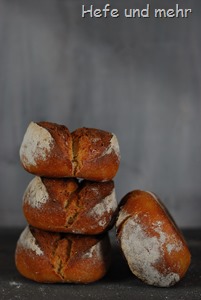
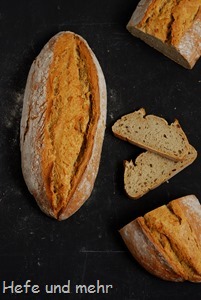
 So here is now the promised Spelt bread. I know that many of the readers of this blog like to bake with spelt, but baking with spelt flour is a little bit more challenging then baking with wheat flour, so the recipe comes relatively late in my bread baking course.
Spelt is closely realted to wheat. But there are two thing to keep in mind when working with spelt. Flour made from spelt contains a different composition of gluten proteins which finally results in a more fragile gluten network. This makes it easy to “over knead” spelt dough, meaning that the dough is kneaded longer then it takes to obtain full gluten development which ends in breaking down the gluten network once again. Due to this fact I prefer to knead spelt dough by hand which gives me a better control then kneading with the kitchen machine. If kneading with the machine it is important to keep a close eye on the dough and testing the gluten development by the window pane test. Intervall kneading (kneading shortly with breaks in between) can be handy as well. Continue reading

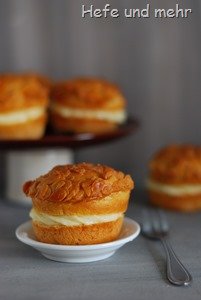 “Bienenstich” is a traditional german cake and its name literally means “bee sting”. For me it is a classical cake to serve on Sundays together with some coffee. When my parents visited us last sunday, I decided to make some muffin sized little Bienstich. Their dough is a “sibling” of my actual
 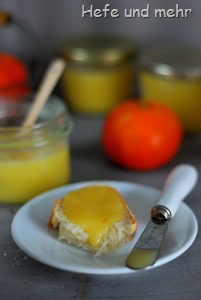 Two Kilogram of bitter oranges found their way into my kitchen last week. Not for making marmelade – there I prefer the sweet variant – but for making candid orange peel! But for making candid orange peel I needed to juice all of them. And I was suprised about the great flavour of the juice, combined with a clear tartness. And there was no trace of bitter flavour.
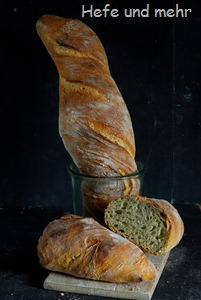 In the last days, the weather was warm and sunny and it finally feels like real spring. The first trees started to flower and the leaves will develop soon and the world will be green once again. And already the first fresh herbs can be found in garden and forest, like wild garlic, ground elder and salad burnet. Blended together this herbs yields an aromatic paste which adds a great flavour to this crusty bread and turns the crumb slightly green.
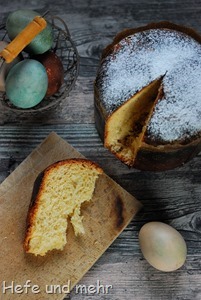 Sometimes you stumble over a recipe and then it catches you so much, that you change all your plans just to bake it. For me this happend when I read about the Schiacciata di Pasqua, the Tuscan Easter bread similar to Panettone. It is baked with olive oil, what tempted me very much. And because I was feeding my