Yearly Archives: 2011

May 15th, 2011

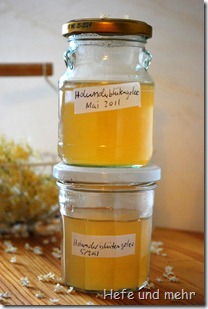
Elderflower jelly

Holunderblüten-GeleeThis year is a good year for elderflowers and due to the warm weather of the last weeks they are flowering very early.

Because I like their taste very much I already picked a lot to bake elderflower pancakes, make elderflower vinegar and elderflower jelly.

For the elderflower jelly I changed the recipe I used last year a little bit. Last year I soak elderflowers and lemon slices for 24 hours in water and used this extract to cook a jelly. It tasted good bad had a slightly bitter aftertaste. So this year I decided to use lemon juice instead of lemon slices.

The taste of the jelly is much better now. The taste is milder and the flavour of the elderflowers is more dominant in the jelly.


Continue reading

May 9th, 2011

Seeded bread with sourdough a la Hamelmann

Saatenbrot mit Sauerteig nach HamelmannWhen Lutz describes a bread with the words “a new favourite” then I know that I have to try this bread by myself. And a bread with sourdough, whole wheat and seeds is always tempting for me.

And so I did not wait long until I bake this recipe. I made some small changes, like roasting the seeds before soaking them and I made the sourdough with freshly milled wheat. My third change is that I bake the bread a little bit longer, so that I get thick aromatic crust.

The resulting bread is delicious, an easy to handle dough, with a very good ovenspring and a great taste. I can just repeat what Lutz already said: A new favourite! Continue reading

May 8th, 2011

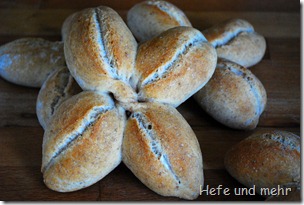
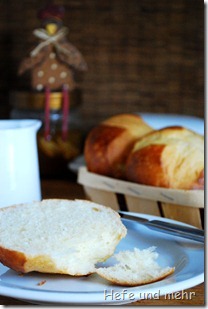
Windmill rolls

WindmühlenbrötchenWhen Susan blog about how to shape a bread to a pinwheel I was hooked. I liked the form very much and thought directly about using this shape for rolls. And on saturday I tested this Idea.

Because rolls are much smaller and I did not want to roll them to thin  I decided to lay them just crosswise without curving the blades of the wheel. So they look more like a windmill now. Thats why I call them windmill rolls.

This rolls are perfect for barbeque or to be served with soup or salad. Continue reading

May 2nd, 2011

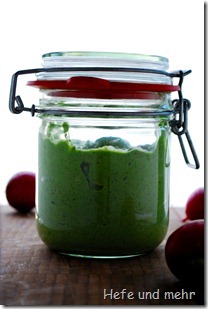
Radish Leaf Pesto

Radieschen-Pesto

At this days, when the whole world wears a beautiful late spring time green. And I do not like to waste a tiny bit of the green leaves you can find in our kitchen. And when we had radish with nice green leaves in our weekly organic vegetable bag I feed our guinea pigs with the leaves or we eat the leaves ourself.

As a pesto radish leaves are an enrichment for our table and pasta with this pesto is a dish which is made quickly. That makes it to a favourite dish for dinner on long workdays.

Additionally to the leaves I add some radish to the pesto, too, to enhance the radish taste.

When you have leftover pesto you can add an oil layer above the pesto and keep it in the fridge for some days.


Radish Leaf Pesto

  • 70g Radish leaves
  • 3 radish
  • 70g almonds
  • 50g Parmesan
  • 40g olive oil
  • 2 garlic gloves
  • 5g Salt

Wash the radish leaves and pat dry. Then place all ingredients in a food processor and mix until homogenous.

Continue reading

May 1st, 2011

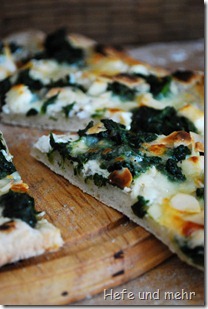
White Spinach Pizza

Weiße Spinatpizza

At the blog Baking Banter of King Arthur Flour MaryJane Robbins posted a recipe for a white Pizza, with no tomatoes at all. Instead of Tomato sauce the pizza is spread with ricotta and topped with spinach, feta, garlic and mozzarella. And then I saw on Susans blog her great farmer market pizza and my wish to try a white pizza increased.

And Pizza is always loved in this house so my question if we should bake this kind of pizza for lunch was positively answered. For the crust I played once more with this recipe. I like it because I can use the remaining dough to make a great bread, too. I added a Pâte fermentée to the recipe to make the crust even more tastefully, and used only wheat flour instead of mixing spelt flour and wheat flour.

For the topping I used the things mentioned in the recipe on Baking Banter and was rewarded with a delicious pizza.

I am sure that white pizza will appear now more regulary on our table. Continue reading

April 26th, 2011

Little Easter nests

Osternestchen 2I did not only bake something for Breakfast at Good Friday, I also wanted to have something nice for our Easter Breakfast, of course. And so I decided to bake little nest of sweet yeasted dough this year. In the past I filled them with a hard boilde egg before baking, but the natural dyes seem to loose their colour when baking in the oven. ‘That’s why I make the nest a little bit bigger,  and place the egg in the middle of the nest after baking.

The dough is made with sour cream, which adds a nice taste to the bread and makes the crumb fluffy. To make the baking day more relaxed I decided to let the dough rise in the fridge, the cold and long fermentation together with the Pâte fermentée adds a complex taste to the bread.

I liked the taste of this little easter nests very much and I am sure that soon I will try this dough for sweet buns, too. Continue reading

April 23rd, 2011

Easter eggs coloured with natural dyes

Ostereier natürlich gefärbtI love to test different natural dyes for Easter eggs. And so I try each year different dyes which I extract from plants and spices.
This year I decided to use tumeric, red cabbage and red beets. I started to collect peels from red beets when cooking already some weeks ago and keep them in the freezer until now. With the red cabbage I use the fact that the anthocyanin which gave the colour to the leaves is pH sensitive and  change colour depending on the pH. A high pH gave a green-blue colour, while a low pH change the colour to red.

I used the red cabbage dye at a neutral pH for staining dark blue-green eggs, while increasing the pH with soda leads to light green eggs. The most suprising fact is that the red solution which had a low pH because of the vinegar resulted in bright blue egg. I never expected such a bright colour because I used brown eggs. Continue reading

April 22nd, 2011

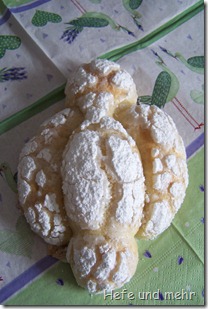
Pani di cena

pani di cenaThis week Petra baked a delicious looking Sicilian Easter buns: Pani di cena. It is a bread that is traditionally baked on Good Friday and which is often glazed with icing and topped with sugar sprinkels. I fell in love with this buns directly and decided to serve them for breakfast on Good Friday.

I changed the recipe a little bit depending on my personal habits – I used the pulp of a vanilla bean instead of vanilla extract and because of the high amount of sugar and butter I decided to add them at the end of kneading, so they couldn’t interfere with the gluten development. After forming the buns I placed them in the fridge, but they didn’t rise so much here because the butter in the dough get stiff in the cold.

The next morning I preheat the oven to 30°C and let the buns rise there for 1 hour, in this time they doubled their volume!

During baking the smell of the buns was seductively: a scent of butter and vanilla filled the kitchen. And tasting them after they cooled down proofed that their scent did not promise to much.  A very rich sweet bread, that reminds me of brioche, incredible soft, buttery and luxurious. Continue reading

April 9th, 2011

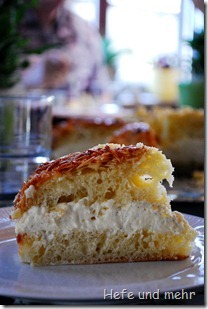
Bienenstich

BienenstichSome weeks ago I promised my sisters fiancée to bake some Bienenstich (Bee sting) when we meet to drink coffee in their new house. But then I was busy in the lab and so I bake fast and easy nut triangles instead. The next time we planned to meet for cake and coffee I was ill and bake nothing at all. But when I was thinking about what to bake for my mums birthday last week the promised Bienenstich seemed to be perfect.

Bienenstich is a traditional german yeast cake topped with a crunchy almond layer and filled with a  vanilla pastry cream

Because I like the taste that Pâte fermentée adds to a sweet yeasted dough I decided to vary my old recipe. And because my kitchen machine does not work so nice with small amounts of dough (everything less then 500g flour ) I decided to knead the dough completely by hand. That was a little bit difficult because the dough is very soft and tend to stick to hands and counter. But it is good to resist the temptation of adding more flour because the softness of the dough will result in a fluffy and soft cake. Continue reading